


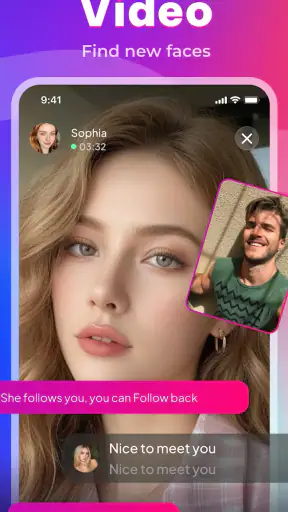
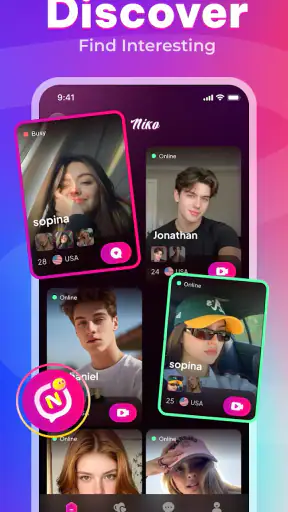

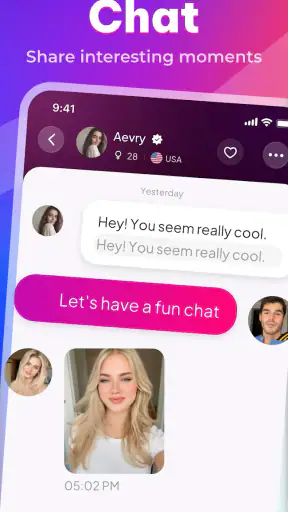
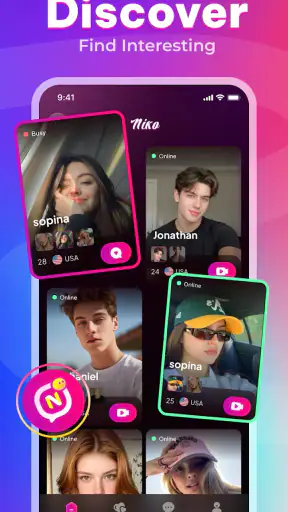

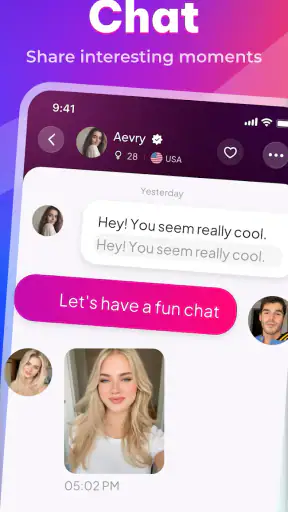
I approached Niko - Video Chat, Share Fun as a lifestyle app for the moment when ordinary messaging feels too flat and you want a more immediate way to discover people and exchange moments. My first impression was mixed: the idea is easy to understand, but the experience depends heavily on who is available, how comfortable you are with mature social spaces, and how much patience you have for a service that still feels like it is finding its footing.
The app is free to install, which makes trying it relatively simple. It comes from VIRTULINK TECHNOLOGY LIMITED and is intended for mature users aged seventeen and over. That age label matters here: this is not an app I would hand to a younger family member or recommend casually without discussing privacy, boundaries, and the risks that come with video-based contact with strangers.
From wanting a quick conversation to deciding whether Niko fits
The starting condition is straightforward. Imagine finishing work, sitting at home, and wanting a more human interaction than a text thread can provide. You may want to meet someone new, share a small moment from your day, or simply see whether a spontaneous conversation feels more enjoyable than scrolling through another social feed. That is the space Niko tries to occupy.
Its store summary, “Discover People, Share Moments,” points to a service built around social discovery rather than a conventional utility. I would not compare it directly with a calendar, a photo editor, or a private family messenger. Its closest alternatives are the familiar social and video-chat apps where the value comes from the people you encounter, not from a fixed library of tools.
That distinction changes how I judge it. With a productivity app, I can test a feature and know whether it works. With a discovery-focused social app, the quality of the outcome depends on the available community, the pace of interaction, and the way users behave. Niko can feel lively when the flow matches your expectations, but it can also feel uncertain because the app cannot guarantee that every conversation will be interesting, respectful, or worth your time.
Before starting, I would make one practical decision: what kind of interaction am I actually looking for? If the answer is a planned call with people I already know, a standard messenger is usually the better choice. If the answer is meeting unfamiliar people through a more immediate format, Niko makes more sense. Going in with that distinction prevents disappointment and helps you recognize the app’s intended use instead of treating it as a replacement for every social tool on your phone.
What the first session asks from you
The first session should be treated as a short trial, not as a commitment to spend the whole evening there. I recommend checking the basic flow calmly, noticing how quickly you reach the people or conversations you want, and deciding whether the app’s social atmosphere suits you. That is more useful than judging it from the concept alone.
A good test is to set a personal limit before you begin. Give yourself enough time to understand the experience, but do not assume that a longer session automatically produces better conversations. Social discovery apps can encourage passive browsing, and the line between “I am looking for someone interesting” and “I am simply waiting for something to happen” can become surprisingly thin.
There is also a useful privacy habit here: keep your first interactions general. I would avoid sharing a workplace, home location, daily route, financial details, or anything that could identify you outside the app. Video makes a conversation feel personal very quickly, but familiarity is not the same as trust. A plain background and a deliberately limited profile can give you more control while you learn how the service works.
Following the flow from discovery to conversation
The central workflow is easy to describe: open the app, look for people, choose an interaction, and decide whether the exchange deserves more of your attention. The important part is what happens between those steps. Discovery is not the outcome; it is only the handoff from browsing to a real conversation.
I found it helpful to evaluate each interaction with three simple questions. Did the person communicate clearly? Did the conversation feel mutual rather than one-sided? Did I feel comfortable continuing? These questions sound obvious, but they prevent the novelty of video contact from overriding common sense. A technically smooth call can still be a poor social experience.
For someone using Niko after a long day, a realistic routine might look like this: spend a few minutes exploring, start one conversation, exchange light topics such as hobbies or recent activities, and leave if the tone becomes uncomfortable or repetitive. The useful outcome is not necessarily a new friendship. Sometimes the result is simply learning that this style of interaction is not for you, which is still a valid conclusion before investing more time.
One non-obvious trade-off is that immediacy can remove the helpful pause that text provides. In a message, I can think before replying, ignore a question, or end the exchange without the same social pressure. Video contact is more direct, but that directness can make awkward moments feel larger and can make it harder to judge someone carefully. I would choose Niko when spontaneity is the point, not when I need maximum control over every interaction.
Managing handoffs between strangers, conversations, and decisions
The handoff from one person to another is where a discovery app either feels efficient or tiring. Each new contact requires a small reset: understand the tone, decide what to reveal, and work out whether the conversation is worth continuing. If those transitions are smooth, the experience can feel social and energetic. If they are repetitive, the app starts to resemble a queue of introductions rather than a place for meaningful connection.
I would use a consistent opening rather than improvising personal details every time. A neutral greeting and a broad question about interests give the other person room to respond without exposing much about me. If the reply is dismissive, overly intrusive, or immediately pushes past my boundaries, I would end the interaction instead of trying to rescue it.
This is also where handoffs outside the app deserve caution. A new contact may suggest moving to another messenger, sharing a phone number, or continuing on a different social network. That can feel like progress, but it also removes some of the separation that made the first conversation safer. My advice is to delay that move until the person has shown consistent, respectful behavior over time. A pleasant first exchange is not enough evidence on its own.
Another practical insight is to separate social success from contact accumulation. Collecting more conversations does not necessarily mean the app is working better for you. I would rather have one comfortable, memorable exchange than several rushed interactions that leave me drained. Users who enjoy rapid discovery may see that differently, while people seeking a quiet, dependable connection may find the repeated handoffs frustrating.
What counts as a successful result
The result Niko offers is flexible. For one person, success may be a spontaneous conversation that brightens an otherwise dull evening. For another, it may be finding people with shared interests. A third user may simply enjoy the feeling of being able to reach beyond their usual circle. The app is strongest when expectations stay realistic and the user understands that discovery is part of the experience, not a promise of a particular relationship.
I would recommend it most to adults who are comfortable initiating conversations, can leave interactions without guilt, and enjoy the unpredictability of meeting unfamiliar people. It may also suit someone who wants a lighter social routine rather than a carefully organized community. The free entry point lowers the barrier to testing that routine, although optional purchases ranging from ninety-nine cents to ninety-nine dollars and ninety-nine cents per item mean I would pay attention before spending.
My spending advice is simple: use the free experience long enough to decide whether the people and pacing are genuinely useful to you. Do not buy anything merely because a conversation was disappointing or because you feel pressure to improve your chances. A purchase cannot solve a mismatch between your expectations and the type of social environment the app provides. If the basic flow does not feel comfortable, spending more is unlikely to change the underlying fit.
The app’s current version is 1.3.0, and it supports devices running Android 7.0 or newer. That broad compatibility is convenient for people using older phones, but compatibility alone does not tell me whether the experience will feel equally comfortable on every device. Video-oriented interactions are more demanding for attention than ordinary text messaging, so I would test it on the phone I actually plan to use rather than assuming that installation guarantees a pleasant session.
Where the workflow breaks down
The clearest warning sign is the average rating of 2.1 from around 1.7 thousand ratings. I do not treat that number as a complete verdict, because social apps can attract unusually strong reactions from both satisfied and frustrated users. Still, it is too low to ignore. It tells me to approach Niko as an app that may involve friction, uneven experiences, or expectations that are not being met consistently.
Its reach is substantial, with over one million installs, yet popularity does not automatically translate into a good conversation for every user. A large audience can improve the chance of finding someone active, but it can also make the experience feel less personal. More people means more possibilities, not necessarily better matching or more thoughtful exchanges.
The review volume is much smaller than the overall rating count, with twelve written reviews. That makes the numerical score noticeable but leaves less detailed public context for understanding exactly why users feel dissatisfied. I would therefore combine the rating with my own short trial and avoid making a major decision based on the score alone.
There is also a basic emotional friction that no feature can remove: conversations with strangers can be awkward, interrupted, or simply boring. If you prefer predictable contacts, clear moderation expectations, and established communities, a private messenger or a more mature social network may be a better alternative. Those services usually make it easier to build around known friends or interest groups, while Niko’s appeal comes from the uncertainty of discovery.
Users who are sensitive to unwanted attention should be especially selective. I would not use this kind of app when distracted, tired, or in a situation where I cannot leave a conversation comfortably. The ability to end an interaction is part of the workflow, not an admission of failure. If someone ignores a boundary, asks for sensitive information, or makes the exchange uncomfortable, leaving is the correct result.
How Niko compares with familiar alternatives
Compared with a standard messaging app, Niko is more spontaneous but less predictable. A messenger is usually strongest when I already know whom I want to contact. Niko is aimed at the earlier stage, when I am open to discovering someone. That makes it more suitable for curiosity and casual social exploration, but less suitable for dependable communication with friends, relatives, or coworkers.
Compared with a large social network, the experience is narrower and more immediate. A social network gives me posts, profiles, comments, and time to observe someone before speaking. Niko puts more emphasis on the conversation itself. That can feel refreshing if I dislike endless feeds, but it also means I have fewer layers of context before deciding whether a person is trustworthy or interesting.
Compared with a dedicated video meeting service, Niko is clearly more social and less task-focused. Meeting tools are designed around known participants, schedules, and a defined purpose. They are the better option for work, classes, appointments, or family calls. I would choose Niko only when the open-ended social element is what I want.
This comparison leads to a useful rule: choose the app based on the handoff you need. If you are moving from an existing relationship to a call, use a familiar messenger. If you are moving from curiosity to a new social contact, Niko is the more relevant experiment. If you are moving from planning to a structured group meeting, use a meeting platform instead.
My practical routine for using it safely
I would begin with a short, low-pressure session and keep personal information deliberately broad. I would judge conversations by respect and reciprocity rather than by how quickly someone wants to continue elsewhere. I would also keep purchases off the table until the free experience proves that Niko adds something valuable to my routine.
For a better outcome, I would use it at a time when I can pay attention. Video-based social contact is not ideal while commuting, multitasking, or handling private work. A quiet setting helps me notice whether the exchange is genuinely comfortable, and it reduces the chance of revealing more of my surroundings than intended.
I would also treat the mature age rating as a practical usage instruction, not merely a label. Adults can still encounter behavior they do not want, and the right response is to end the interaction promptly. I would never use a social discovery app as a substitute for professional support, emergency communication, or a trusted relationship.
The most important test is not whether Niko can start a conversation, but whether it helps you finish one feeling respected and in control. That is the point at which the workflow becomes meaningful. If every interaction leaves me rushed, uncertain, or pressured, the app is not meeting my needs even if the connection itself works.
Final assessment after following the complete workflow
After looking at the journey from initial curiosity through discovery, conversation, handoff, and outcome, I see Niko as a specific kind of lifestyle app rather than an all-purpose social solution. It can be appealing when I want a spontaneous video-oriented interaction and accept that the quality will vary. It is less convincing when I need reliable contacts, carefully filtered communities, or a calm way to communicate with people I already know.
The free installation makes experimentation reasonable, while the mature rating, optional purchases, and low average rating make a cautious approach sensible. I would not recommend rushing into paid features or assuming that a large install base guarantees a polished social experience. Instead, I would try the basic flow, protect my personal information, and decide based on the quality of actual conversations.
My recommendation is therefore selective. Adults who enjoy meeting unfamiliar people and can handle uneven social exchanges may find a worthwhile use for it. People who dislike video contact with strangers, want strong predictability, or need a private communication tool should skip it and choose a conventional messenger or a more established community service. For me, Niko is worth a careful trial, but only with clear boundaries and modest expectations.


